
The three posters present the STEEPNESS [modèleS évaluaTion formEs socialEs aPpreNtissages ouvErteS réSeau] project’s conceptual and practical framework.
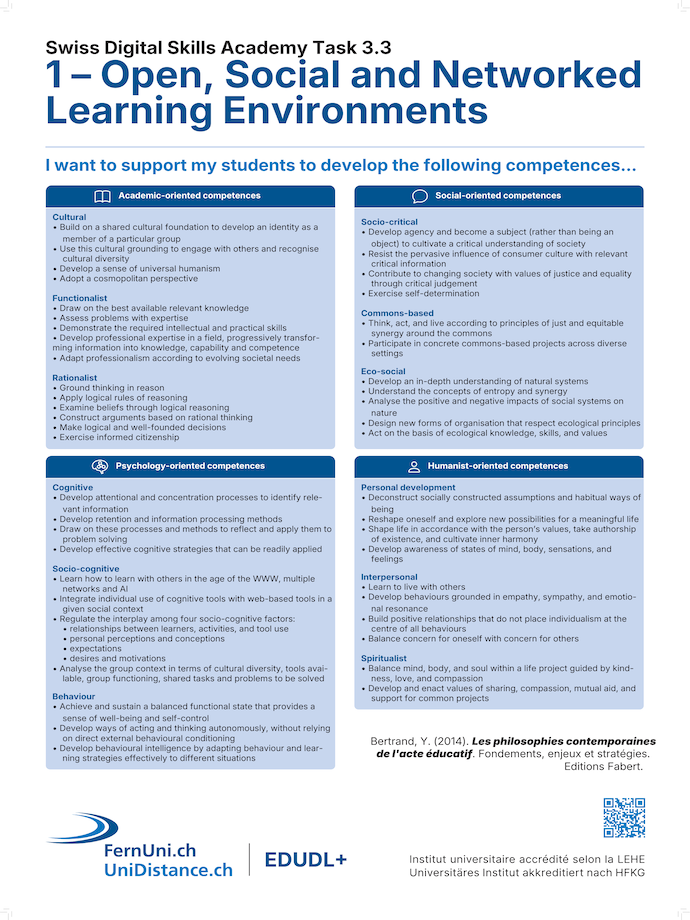
Poster 1 provides educational foundations in the form of philosophical approaches. It is based on Yves Bertrand’s 4 main families: academic, that focuses on knowledge and competences; psychological, focusing on learning; social, which purpose is to act in society; and, finally, humanistic, which purpose is to become a person in the sense of von Humboldt’s concept of Bildung. Each family has an icon. The poster presents 45 competences that teachers may wish to use to design their course. Thus, using the STEEPNESS conceptual framework to identify competences is one concrete design option.
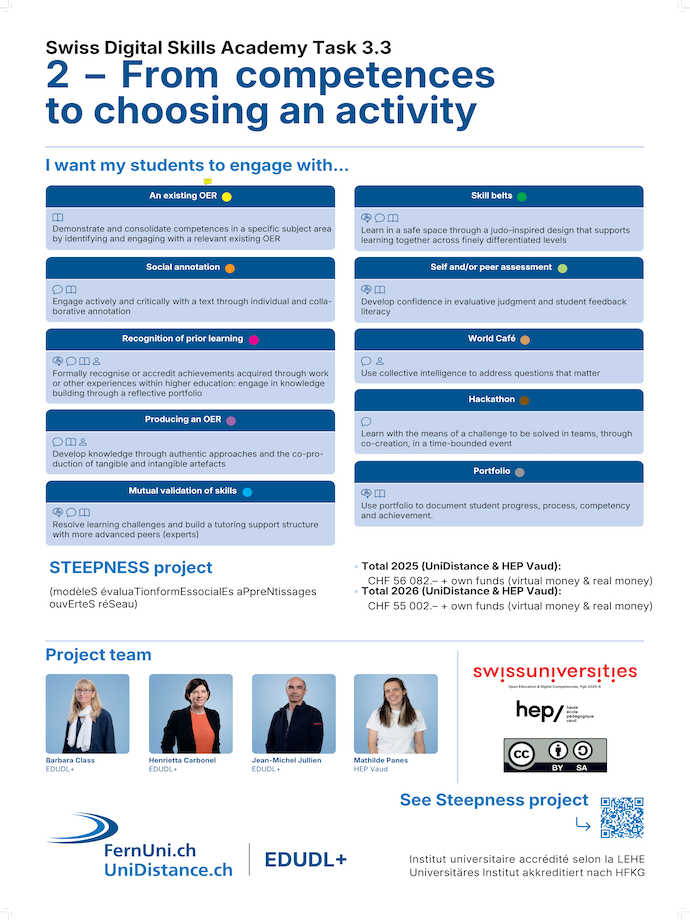
Poster 2 presents ten activities suited to Open Education: Open Educational Resources (OER) – either identifying an existing one or creating a new one, social annotation, recognition of prior learning, skill belts, self and peer assessment, World Café, hackathon and portfolio. Each activity is described through its pedagogical purpose. For each activity, the icons representing the four families introduced in Poster 1 indicate the orientation that the activity is best suited to support. Each activity is also provided with a colour that is used in Poster 3. The STEEPNESS conceptual framework may be used here to identify a relevant activity.
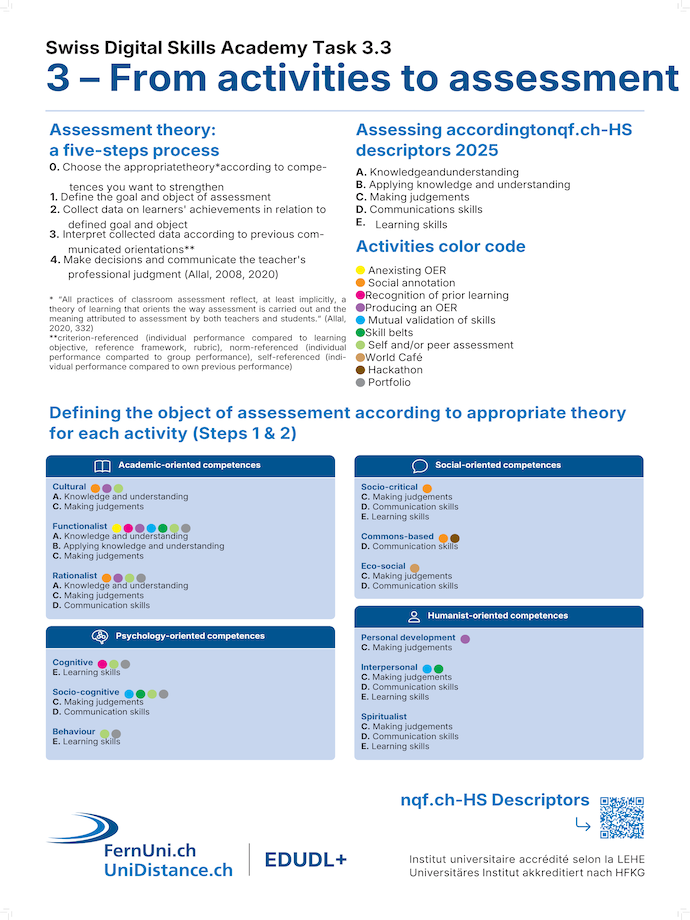
Poster 3 focuses on assessment. On the top, it presents the four-step process derived from Allal’s work – defining the assessment goal, collecting evidence, interpreting it, and finally, making and communicating a professional judgement – and the Swiss normative framework, i.e. the five nqf.ch-HS descriptors. The second half of the poster links philosophical families and competences of Poster 1, activities of Poster 2 and Nqf descriptors of the top of the poster. This matrix can be read in either way: with which Nqf descriptor shall I assess an activity? How best to identify steps 1 and 2 of the four-step process for a given activity? I am currently not addressing descriptor x of the Nqf and need to find an activity to do it.
Allal, L. (2008). Evaluation des apprentissages. Dans A. van Zanten (dir.), Dictionnaire de l’éducation. Presses Universitaires de France.
Authier, M. et Lévy, P. (1999). Les arbres de connaissances. La Découverte.
Bertrand, Y. (2014). Les philosophies contemporaines de l'acte éducatif. Editions Fabert. https://doi.org/10.14375/NP.9782849222645
Koehler, M. et Mishra, P. (2009). What is Technological Pedagogical Content Knowledge? Contemporary Issues in Technology and Teacher Education, 9(1).
Swissuniversities. (2025). Cadre de qualifications pour le domaine des hautes écoles suisses. nqf.ch-HS. https://www.swissuniversities.ch/fileadmin/swissuniversities/Dokumente/Lehre/NQR/nqf-ch-HS-f.pdf